
The Broken Default: Selling to People Who Aren't Ready
The default growth playbook is straightforward: generate traffic, show the product, hope for conversion. Run ads to landing pages. Push features. Offer discounts. Chase leads who showed even a flicker of interest.
The problem isn't that this approach doesn't work at all. It's that it works at an enormous cost — both in acquisition spend and in brand erosion. You're asking someone to make a buying decision before they fully understand why they need what you're selling.
Think about the last time someone tried to sell you something you didn't fully understand. Your default response wasn't excitement — it was scepticism. That's what happens when companies lead with the product instead of the problem.
The Education-First Principle
Education-first growth is built on a simple observation: people buy solutions to problems they understand. If your prospect doesn't yet have language for their pain, no amount of product messaging will convert them.
Rather than fighting this reality with louder ads and bigger discounts, education-first companies work with it. They invest in helping their audience understand the problem, the landscape of possible solutions, and the frameworks for making a decision — before positioning their product as the answer.
This isn't content marketing in the traditional sense. It's not SEO blog posts stuffed with keywords and gated behind email captures. It's genuinely useful material that changes how someone thinks about their problem.
"When you educate someone, you don't just earn their attention — you earn their trust. And trust is the currency that makes every subsequent conversion easier."
The Ascending Value Model
The most effective education-first companies don't just teach and then sell. They build what we call an ascending value model — a structured path where each interaction delivers more value, builds more trust, and naturally leads toward a commercial relationship.
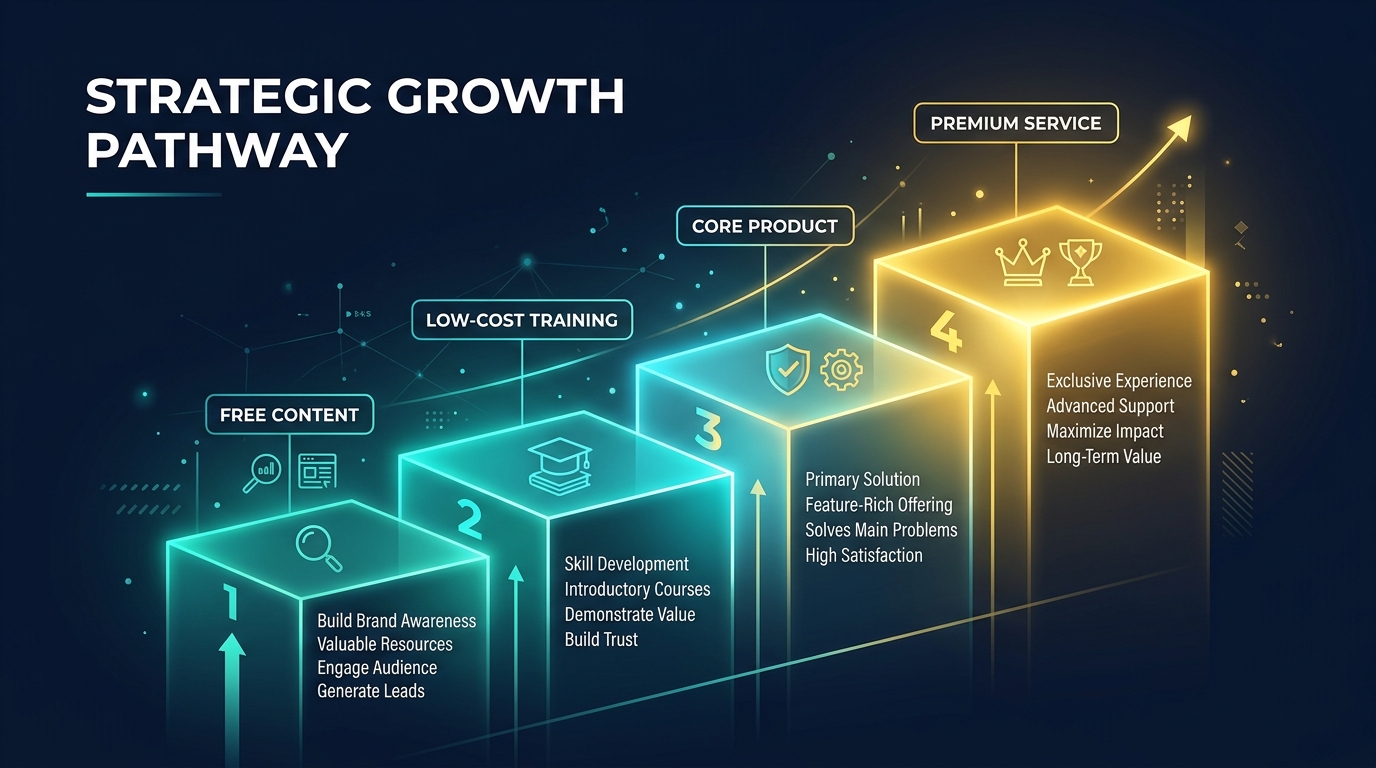
The model works in four stages:
Free Education
Open content that reframes the problem. Articles, videos, frameworks that change how your audience thinks. This is where trust begins — not with a sales pitch, but with genuine value.
Low-Cost Training
Structured courses, workshops, or masterclasses at an accessible price. This filters for serious prospects while covering your acquisition costs — making growth self-funding.
Core Product
Your primary offering — the software, platform, or service that solves the problem at scale. By this point, the prospect already understands the problem and trusts your approach.
Premium Partnership
High-touch consulting, done-for-you services, or equity partnerships for those who want the maximum outcome. Reserved for the most aligned relationships.
Each step up the model is a natural progression — not a hard sell. The customer moves forward because they've received genuine value at each stage and want more. This is fundamentally different from the "free trial to paid" conversion trap that most SaaS companies rely on.
Why This Works: The Self-Liquidating Growth Engine
The most powerful outcome of education-first growth isn't just better conversion rates — it's that your growth becomes self-funding.
Consider the typical SaaS model: spend money on ads → drive traffic to a free trial → hope some percentage converts → wait months to recoup acquisition costs. The payback period kills cash flow and limits how aggressively you can grow.
Now consider the education-first model: spend money on ads → drive traffic to educational content → sell low-cost training that covers your ad spend within days → the product converts naturally from the educated audience. Your advertising costs are recovered immediately, and every product conversion is pure profit.

This is how bootstrapped companies outspend venture-backed competitors. When your front-end education covers acquisition costs, you have unlimited budget to reach new audiences. You're not burning runway — you're building a growth engine with a seven-day payback window.
Typical payback window
Higher conversion rates
Close rate from educated audiences
The Three Laws of Education-First Growth
After building multiple companies on this model, we've distilled the approach into three non-negotiable principles:
1. Teach the Problem, Not the Product
Your educational content should make someone smarter about their challenge — not about your features. If a competitor could use your content to sell their product, you're doing it right. The goal is to become the trusted authority on the problem space. When you own the problem definition, you naturally own the solution conversation.
2. Make the Education Itself Valuable
The education must stand on its own as genuinely useful — even if the person never buys. This seems counterintuitive, but it's what separates education-first from content marketing theatre. When someone implements what you teach and gets results, they don't think "I don't need to buy." They think "imagine what I'd achieve with their full solution."
3. Build the Relationship Before the Transaction
Every interaction should deepen the relationship, not just push toward a conversion. This means consistent communication that respects the prospect's journey — sharing stories, insights, and frameworks that build connection over time. The sale becomes a natural next step in an existing relationship, not a cold transaction between strangers.
From Theory to Execution: The Weekly Rhythm
Education-first growth isn't a one-off campaign. It's an operating rhythm. The companies that scale fastest on this model commit to a consistent cadence of teaching — usually weekly — and treat it as seriously as they treat product development.
The rhythm looks something like this:
- →Weekly live sessions where you teach, answer questions, and demonstrate expertise in real-time. These can't be faked or polished to the point of feeling corporate.
- →Ongoing narrative sequences — structured communication that takes your audience on a journey, building on each previous interaction rather than starting from scratch every time.
- →Feedback loops — using real-time audience interaction to refine your messaging, understand objections, and identify what resonates. This is intelligence gathering disguised as generosity.
The key insight: do this live, at least 50 times, before you even consider automating. Every session teaches you something about your audience that makes the next session better. Automating too early freezes your understanding at an immature level.
The Competitive Moat Nobody Copies
Here's the strategic advantage most companies miss: education-first growth creates a moat that's nearly impossible to replicate quickly.
A competitor can copy your features in months. They can match your pricing overnight. They can outspend you on ads with enough capital.
But they cannot copy the relationship you've built with an audience that trusts you. They cannot replicate the authority you've earned through consistent, genuinely valuable education. They cannot shortcut the journey from "stranger" to "trusted advisor" that takes months of showing up and delivering real insight.
This is why education-first companies tend to be remarkably resilient — they're not dependent on any single channel, algorithm, or promotional tactic. Their growth is built on a relationship with their audience that transcends platform changes.
Want to Build an Education-First Growth Engine?
We help companies design and implement education-first acquisition models that fund their own growth. If you're spending heavily on ads with diminishing returns, there's a better way.
Start a Conversation